Resource
RevOps Guide to Territory Equity
Published June 27, 2024 by Kevin Davis · Updated March 31, 2026
“Territories are not fair.””My accounts are bad.”
“Territories are not fair.””My accounts are bad.”
”This team has a better shot to achieve quota than us.”
“My quota makes no sense.”
“I don’t have any accounts in industry X, which is easier to sell into.”
“My accounts are the wrong size.”
- Everyone
If you’re in RevOps, your suggestion box has likely been filled with the above comments about 'bad' territories (or Target Account Lists or Books of Business). Territory equity is a hot-button issue in all sales orgs. Second only to unfair quotas, Sellers and Sales Leaders will voice their concerns if they believe their territory lacks opportunity. But RevOps needs to allocate accounts in a way that maximizes the company's chances of hitting its numbers and promotes future growth. Even though hurt feelings are unfortunate, should territory equity be a priority? This guide illustrates the impact of territory equity in promoting growth and how to design equitable territories.
These things become really hard when territories are not equitable:
Retaining reps
Sales Reps and Sales Leaders are right to advocate for the best possible territory. More than other employees, sales is paid in a variable system. The more deals they close, the more income they make. The harder the quota, the harder it is to earn money. Therefore the quality of territory directly affects the life of a salesperson. If you are assigned to the Nike account and Nike is not a good fit for your product, you should complain! You should say, ‘Please don’t make me sell to Nike! They’re not going to buy it!’
And it’s not just about money. If reps don’t close deals, they don’t get promoted. Internal recognition for sellers is not achievable if they don’t close deals..
And it’s not just about the recognition. There is a human element…asking a seller to sell into a bad territory is like telling someone to shove a round peg through a square hole. It is unpleasant to call people that are not interested in buying what you’re selling.
Territory equity directly impacts retention; if a rep is assigned a bad territory, they are within their rights to seek opportunities elsewhere. And losing reps not only leads to missed targets but also crushes company culture.
Our friends at Repvue have studied rep retention and found that:

Setting quotas
Territory equity isn’t just about pleasing reps. It has downstream implications. How do we set quotas for reps if territories aren’t equitable? The answer: variably. We have to say that X Territory is Y% healthier than Z territory…therefore the Quota should be Y% higher for Territory X. This math considers many variables and takes time to implement at scale. When sellers talk about quotas (which they will), this math will quickly go into a microscope.
Benchmarking performance
It is a classic “chicken-or-the-egg” problem. Was it the rep that failed?...Or was the territory just really bad? Was the rep amazing?...Or was the territory a cakewalk? Like quota setting, performance benchmarking with unbalanced territories takes data normalization and lots of time. If territory health isn't quantifiable, measuring rep performance with any relativity becomes nearly impossible. However, if all reps begin the race at the same starting line, the results are much easier to interpret.
Planning capacity
If there’s no standard for what is a territory, how do we know how many accounts can a rep really work? How many reps do we need to hire? It’s impossible to properly assess the needs of a sales org if each territory is a snowflake. Like quota setting and performance management, capacity planning within an unbalanced and unquantifiable territory model requires sales leadership to perform gut analysis and make decisions based on limited data or historical biases. Within a balanced territory model, the objective territory coverage metrics required to make capacity planning decisions are readily accessible.
So how do we get balanced territories?
It is impossible to talk about territory balance without first providing a clear definition of a healthy territory. Without a clear definition, sales teams and stakeholders will come up with their own subjective rationale for determining territory fairness. This rationale then becomes ingrained in the company culture as the de facto standard for assessing territories. Therefore, defining a healthy territory becomes the cornerstone of achieving balance. Consider these steps:
Research & Define Ideal Customer Profile(s)
Identify accounts that are good targets and the attributes that make them so. Focus on firmographic, technographic, persona, signal, and other attributes that define your best target accounts. Conduct regression analysis on top clients and collaborate with senior executives to compile lists of top target accounts.
To find your ICPs, you need to complete regression analysis on top clients. Meet with senior executives from C-suite, Sales, and Product to get lists of their top target accounts. If they each don’t have a top 10 target accounts list, ask them to build one. Message the ICP definition(s) to the entire organization to gain buy-in, request feedback, and foster alignment. See Rosalyn Santa Elena’s comments on ICP in territory design here:
Common mistakes:
- Skipping this step entirely.
- “The reps are hunters. They will figure out the ICPs.”
- “Let’s rely entirely on intent data and inbound.”
- Setting too broad of an ICP
- “Let’s just based territories on # of accounts.”
- “Let’s use an alphabetical territory model.”
- “We don’t have a top ten must-win prospect list.”
Select Balance Attributes
You now understand which attributes make up strong customer profiles. You will be more sure of some than others. Some will be easier to aggregate into a database. And some will be experimental or newly available data. You now need to select which of these attributes you want to use when designing territories. This represents a primary implementation of your ICP strategy.
Check out
of precise Balance Attributes from Adam Schoenfeld, CEO of Keyplay:
Here are some examples of Balance Attributes from real territory designs:
For territories focused on net-new prospects:
- Account score bands
- Common mistake: Don’t Sum the Account Score
- Common mistake: relying too heavily on account score. Consider deconstructing it.
- Best vertical/industry accounts
- 2nd best vertical/industry accounts
- 3rd best vertical/industry accounts
- High intent accounts
- Experimental account type A
- Experimental account type B
- Has X persona
- Has Y persona
- $ of existing opportunity
- Revenue bands
- X size of department
- ARR
- MRR
- Product usage metrics
- Renewal timing
- Churn risk
Common mistakes:
- Not getting buy-in on balance attributes from sales leadership
- “Here is how we think is the best way to balance territories. What do you think?”
- Not messaging balance attributes to sales
- “Here is how territories were balanced.”
- “Here is what we deem to be a healthy territory and here’s how we got there.”
- Relying too heavily on a single account score and not specifying ‘why’ the account is good or bad
- Don’t Sum the Account Score
-
Using balance attributes not related to ICP
- Ie Alphabetical territories
- Ie # of total accounts
- Ie GDP in a geographical area
-
Define Territory Health using Balance Attributes
There needs to be a singular definition of territory health across reps with the same role. This gives reps a measuring stick for their territories and allows you to distribute the philosophy. It also helps you to ensure that you are focusing on ICPs and testing the ICP hypotheses along the way.
Visualize territory health across teams with:
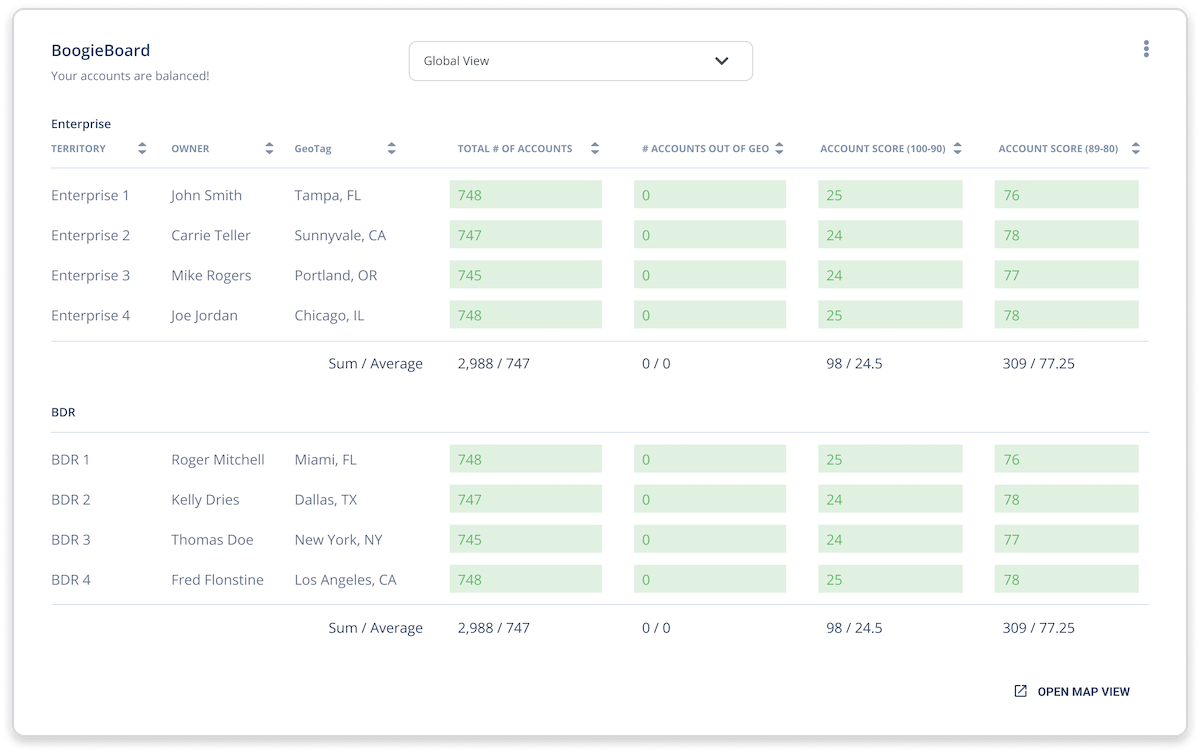
Territory Health Reports
The X axis are your Balance Attributes. The Y Axis are the reps and teams. This should be the standard for driving consistency across territory health. See an example here:
Rep View Reports
The X axis are still your balance attributes. But here you are viewing things at the account level. These reports give each rep a head start in understanding the makeup of the territory and planning to attack it. It also serves as a functional way of actually delivering territories to reps.
Common Mistakes
- No clear definition or measurement of territory health
- Ie Nothing published to intranet stating how territories are designed and why.
- No consistent visibility into territory health
- Ie No live reporting, feedback loop, or communications around territory health and balance
Build an ROE around Equity
Territory design and implementation are only the beginning. Things change throughout the year and make it easy for things to fall out of balance. Reps leave or get promoted. GTM strategies change and products update. Markets fluctuate…and on and on and on.
But now that you have built a clear understanding of a balanced territory, making these changes becomes much easier. Your Territory Health reports make it easy to monitor balance on an ongoing basis and Balance Attributes become key decision making tools throughout the year. As for documenting this ROE, you can use our free template here.
Use a Round Robin Model whenever possible!
The fastest and easiest way to get out of balance is to have inequity with inbound leads. If Rep A gets 6 inbound leads and Reb B gets 1, it may not matter who is doing a better job of prospecting into a territory.
For reps in the same role, try to assign inbound leads evenly to balance the workload and opportunity.
Have a rep that isn’t converting inbound leads? Or you want to skew things one way or another? This is a key indicator that you actually have different roles within your team, a rep is still being ramped, or a rep should be removed entirely. Skewing leads or ‘stacking the deck’ is a temporary solution to fix.
Lock Accounts
Determine a criteria for holdovers and other accounts that will not move over time. This is especially important for accounts that have an existing opportunity or are existing customers. You don’t want them experiencing rep turnover solely for equity’s sake. But for example, if an account manager has been at the company a long time and has compiled lots of strong accounts, you may need to move some to ensure they all get worked properly. If this account manager is capable of handling many more accounts than his peers, it’s time to create a new role and give this rep a promotion into this role.
Build a rep feedback loop
This is part CYA and part research. Your top reps have valuable input in selecting the Balance Attributes that will be focused on. They may also have creative ideas for how to think about territories. Ask your top reps, “who are the top 10 accounts that you’d want to go after and why?” For the rest of your reps, consider a broad survey asking opinions about data sources and balance attributes.
Not only can you incorporate these ideas into your territories and GTM hypotheses, sellers will appreciate being part of the territory design process.
Common Mistakes:
- Not having a clear process for in-year territory changes
- Not acknowledging and changing the balance attributes or other territory components that aren’t working
- Not having clear role delineation
- Stacking the deck of a ‘top performer’
Reconsider Geo-Led Models
If you use a geographical territory model (meaning that you assign geos to reps instead of accounts to reps) understand that it’s very likely to get out of balance. Natural physical boundaries are difficult to parse into equitable areas that fit where reps are located. Geo models are great if you sell a physical product or need to be in person with extreme frequency. But if these aren’t your rationale for geos, consider using time zones to solve for this constraint.
Common Mistakes:
- Over-emphasizing geographical components within territory design
Delight Your Sales Team with Equitable Territories
Avoid cultural issues, missed deals, and forever long processes. Use this guide to implement your ICP, identify balance attributes, and build equitable territories. Your Sales team will appreciate the focused approach. Your Operations partners will love the clarity and efficiency of your process. And your customers will love that your reps are in the right place at the right time.
If you have feedback, please hit us up. If you’d like to learn about BoogieBoard’s Territory Design Copilot (which can help with this), click here: