Resource
The Design Guide for Existing Customer Books of Business
Published July 15, 2024 by Kevin Davis · Updated April 7, 2026
“I left the company because my accounts sucked. When I asked my management and ops teams to fix it, nobody could explain the process to me.”
“I left the company because my accounts sucked. When I asked my management and ops teams to fix it, nobody could explain the process to me.”
-- Account Manager interviewed for this blog
This blog benefits from interviews with 50+ Sales and Ops leaders. It uses the term Book of Business (BOB) to denote an account list worked by a Customer Success Manager (CSM) or an Account Manager (AM). We use the term ‘rep’ as a generic way of talking about either a CSM or an AM that exclusively works with existing customers. We especially want to thank the below CS & AM leaders for their contributions:
- Shiv Shah, Director of RevOps @ Postscript
- Amber Milks, Founder & CEO @ Loop Consulting
- Michael Orndoff, Senior Manager Sales Operations @ EverCommerce
- Abbi Hubler, Founder & Consultant @ Catalyzer
“We know what we are, but know not what we may be.”
-- William Shakespeare / Reps during planning season
When you’re an AM or a CSM, planning season is nerve racking. You just spent the year shepherding your accounts through the customer journey. You learned their businesses, earned the respect of their people, and acted as the face of your company.
But next year, you’re not sure which accounts will be yours. Your manager asked you in a meeting which ones you’d like to keep and which you’d be ok to relinquish. But there doesn’t appear to be a clear process. Next will come the political nightmare of ‘horse trading’ accounts back and forth, where you’ll be an innocent bystander caught in the mess and without influence. You start to think, maybe Forest Gump was right, “"I don't know if we have a destiny, or if we're all just floating around accidental-like on a breeze.”
You cross your fingers and hope to get your account list (box of chocolates?...ok ok…we’ll stop) soon, so you can get to work. You hope that it was thoughtfully designed and gives you a shot to achieve the goals that will be set for you. You hope that it will be fair so that you’re judged on merit. You hope… but you feel a little helpless.
When we started researching for this blog, we couldn’t find articles, webinars, or content detailing the best practices for designing books of business (“BOBs”). It made us think that the quote above is right…there is no process! But we couldn’t figure out why. From our team, which is made up of former AMs and Sales Leaders, to the 50+ Sales and Ops leaders interviewed for this article, everyone had a horror story from book design.
So if nobody is talking about book design, why do we think it matters???
1. It’s a retention exercise for customers!
To customers, CSMs and AMs are the face of the company. They own the relationships and act as shepherds for the customer journey - the main points of contact. This means handling both renewals, upsells, and product adoption. If a customer is experiencing a revolving door of reps, has someone assigned that doesn’t fit, or doesn’t even have a supporting rep, the risk of churn skyrockets (insert data here). Recent economic turmoil has reminded companies that renewable revenue is their lifeblood. Churn from rep instability puts that at risk. Amber Milks reminds CS and AM leaders, “'Your job is net retention, net retention, net retention'”
2. It’s a retention exercise for reps!
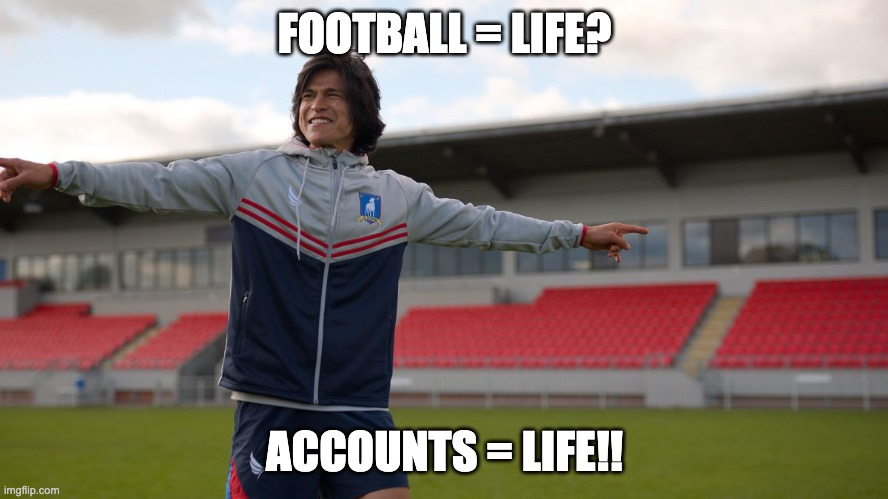
For Dani Rojas, Football = Life. It is where he makes his living, spends his time, and gets his identity. For CSMs and AMs, Accounts = Life! Most reps hold some combination of renewal quota, upsell quota, or customer milestone bonuses. If they aren’t put in a position to succeed (i.e. trying to sell software to a company that is going out of business), it directly impacts their compensation. Michael Ordoff explains, “oh, there's a lot of churn happening in the individual BOB and then we lost that account manager. And then you go back and look at the data, it's like that person was probably checked out for the last six months and overworked for the last year and a half because we had a hiring freeze and we couldn't resource and we couldn't reshuffle the books of business and put them under.” And it’s not just compensation, high-priority accounts translate into visibility and growth in the company. If Dani has to sit on the sidelines (Ted would never), he’d have no choice but to find another team.
3. It impacts the customer journey (and revenue)!
Michael Orndoff likes to remind, “At the end of the day, the customer journey and the customer experience is what's going to increase revenue.” It’s not just about retaining customers, it's about growing them. Land-and-expand revenue models, which have long been in place in traditional industries, are now finding their way to tech. So if it is the role of the rep to renew, upsell, and progress this customer journey, they need to be in place, on the right accounts, at the right time. Putting reps on accounts with no upside is a waste of resources and results in missed opportunities on higher potential accounts.
…So if this process can result in customer churn, reps leaving, and missed revenue, how can you avoid these pitfalls?
Unlike in territory design for new business sales, existing customers have better account data available. Companies have access to more accurate firmographic and technographic information. They’ll also have product, revenue, and customer journey data relative to a specific account. You can therefore be more precise and excellent in the process of designing books.
When designing books, here are some variables to consider:
Roles:
Much is being said about the delineations between Customer Success and Account Management roles (see a breakdown here from Gainsight CEO, Nick Mehta). Customer Success (value/adoption) and Account Management (renewal/expansion) roles handle different functions within the customer journey. Matching the right role to the right account can be tricky. A company doesn't want all of its most seasoned reps on its most mature accounts. It doesn’t want all of its new (and highest upsell potential) accounts going to the most junior reps. Some reps will be more consultative and technical, while others might be more sales focused. Abbi Hubler thinks the setup of these roles is derived from company fundamentals: What are your core values, which then dictate your culture, which then dictate how you communicate and how you represent yourself as a business. It also will dictate how this team is developed so that when you're setting up these reps for success
Consider questions like:
- Should I combine CSM + AM, or keep them separate?
- Should I create roles by segment and seniority?
- What does a balanced book look like for each role?
Productivity:
You want your reps to be fully utilized and your customer to be fully serviced. But it’s a balance. Give reps too many accounts and customer experiences dilute. Don’t give reps enough, and there’s opportunity cost for your resources. Michael Ordndoff says that without tracking of churn metrics and a standardized book design process, “You run into the problem of being able to analyze ‘how effective is that account manager, what is their baselining, their bandwidth today?’”
Consider questions like:
- How many accounts can someone service?
- How can we break up the book to have high effort and low effort accounts?
- Should our reps be on an upsell and/or renewal quota, or a milestone bonus plan?
Segmentation:
Dividing customers into buckets means that you can run scaled operations that fit certain customer categories. You likely have some existing customer segmentation within your business that can be applied or filtered to fit for customer success (i.e. Segmentation by total account potential). Figure out how many customers will be in each segment, then rank them according to priority. Once you have this, you can juxtapose your needs against the resources that you have today. You may need to hire. You may need to promote. You may need to develop a scaled practice to handle maintenance accounts.
- What categories most differentiate our ICPs
- What can we access consistently
- How does Sales do it? Should we mirror them?
Total Account Potential:
This means assigning revenue targets to accounts. It’s best to not expect perfection when doing this, but rather keep a simple, repeatable process. For example, if you sell users, what is the maximum amount of user licenses that the company could purchase? If you sell based on volume, then go for the maximum amount of volume. Shiv Shah of Postscript gave the example, “With every additional product line that we can sell, we want to indicate which products the customer might be willing to buy - whether it's managed services, sandbox, licenses, new processes, whatever it may be - which allows us to score, what the expansion potential could be.”
Consider questions like
- What is the maximum amount of revenue that this account has?
- How many users are available or how much volume can we generate?
- Where are we in relation to full potential today?
Account Status:
Where is this customer in relation to its total account potential? How does this track towards expectations? The goal here is to quantify the upsell opportunity and assign a likelihood to achieving it. This might mean a whitespace analysis, a simple ‘account category’ field, or even just a health score. Again, it’s better to keep it simple and improve over time then it is to get it right in one shot.
- Where is this account in the customer journey?
- What is the remaining whitespace on this account?
- Should we tag it as a churn risk for renewal?
- What is the likelihood that we can capture the Total Account Potential?
Accounts that Shouldn’t Move:
It’s a bad customer experience to have rep turnover. While rep turnover from promotion, attrition, or book redistribution is going to happen from time to time , we should strive to keep it to a minimum. No customer wants to receive the dreaded, “hi…I’m your new account manager” email.Similarly, reps don’t want to claim new accounts that they think someone else was ready to dump. Customer reps tend to be relationship focused and value keeping the accounts with relationships. Your book design needs to include a clear set of rules to determine which accounts can or cannot be turned over Shiv Shah says, “So I think the norm in the market is like, oh, you shouldn't change, like, CSM transitions or account management transitions a lot, but I mean, salesforce does it every year, and they do it for everyone. And we kind of embody the same philosophy because we realize that not only does it actually lead to better retention rates and expansion rates, sometimes you just need to freshen up the relationship. So what we do is we kind of do at the start of every year, we allow CSM to protect up to 25% of their book.”
- How many times has this account been moved recently?
- Is there an existing journey or opportunity that we should avoid disrupting?
- Could this account benefit from a relationship refresh?
Now you have accounts segmented, prioritized, and locked. You have a pool of accounts that can be shuffled around.
Determine Balancing Goals
While the aforementioned variables help with precision, they also make for endless ways to construct books. It’s helpful to create an ideal book, and work backwards. Consider the following questions to help you determine goals for balancing books between reps:
- How many accounts should each rep get, and what should be the breakdown of those accounts?
- How do we think about equity between sellers? Do we need to augment roles to allow for equity?
- How can we use book design to make incentive management simpler?
Once you have clearly defined what a balanced and fair book design looks like, it’s time to start divvying things up and presenting different scenarios to stakeholders. These presentations should make it easy for stakeholders to provide the feedback that you need and make them feel like they have some agency in the process. Consider reports that:
- Show the change from the previous model
- Give a clear view of the design goals
- Offer a simple summary.
Pitfalls to Avoid:
Horse Trading
Stakeholders get competitive about this process and will trade accounts as long as possible. Prevent this by engaging stakeholders at the beginning of the process.
How to avoid:
- Define their list of “locked” accounts that should not move
- Contribute to the balancing goals and ideal outcome
- Understand their agency in the process
Not Communicating With Stakeholders
BOB design is always going to be debated. It directly impacts many stakeholders and their livelihoods. Orndoff says, “It’s not just about making data-driven decisions. I need to be able to explain those decisions to reps and leadership. We all need to be on the same page with the strategy and logic.”
How to avoid:
- Involve stakeholders early and with ease
- Don’t keep the process arbitrary or behind closed doors.
- Acknowledge limitations and make a good faith attempt at maximizing balance
Over-leveraging Geography
Most companies want some geographical component to book design. They’d prefer the rep in Florida not to have all California based accounts. But overemphasizing geography acts as a major constraint when designing books and hiring new reps.
How to avoid:
- Use a simpler approaches like time zones or general proximity ‘
- Don’t use zip code or state based hard logic unless it’s imperative
- Consider using other variables that represent customer community, like industry or technographics
Account Turnover Paralysis
Changing accounts too frequently or in an uncoordinated way aggravates customers. Their imagine of the company, revenue journey, and renewal are all risked.
How To avoid:
- Instead, balance this with the fact that accounts will need to change hands occasionally. Don’t get paralyzed in one direction or the other and find a comfortable approach that works for customers, reps, and the business.
Stacking the deck
If there’s an inkling to give all of the best accounts to a single rep or a subset of reps, this is indicative of other problems.
- The roles are wrong and people are in the wrong position or there is an enablement gap. Roles support a scaled approach, so book design should be very similar at the role level.
- Consider rethinking your roles or enablement strategies.
- You might have the wrong people
If you want some help, or just to share ideas on the topic, connect with BoogieBoard. We’ve built tools and offer managed services to ensure that your BOBs are created quickly and intelligently. We’ve even named our mascot Bob…hi Bob!